Track your gear's value over time
Rental IQ estimates what your equipment is worth today based on age, condition, and market data. Know when it is the right time to sell or upgrade.
You don’t know what your gear is worth
Equipment loses value over time, but not at the same rate. A three-year-old cinema camera depreciates differently than a three-year-old tripod. Without tracking, you’re guessing what your inventory is actually worth.
That guesswork leads to bad decisions. You hold onto gear past its optimal selling window, or you undervalue items that still have significant resale value.
Rental IQ uses market-aware depreciation estimates tuned to production equipment categories, so you always have a current picture of your inventory value.
How it works
We fill in what your gear cost
Most items get a price as soon as you import them, which sets the starting value we depreciate from. Add roughly when you bought each piece, and correct the price if you paid something different.
Rental IQ estimates current value
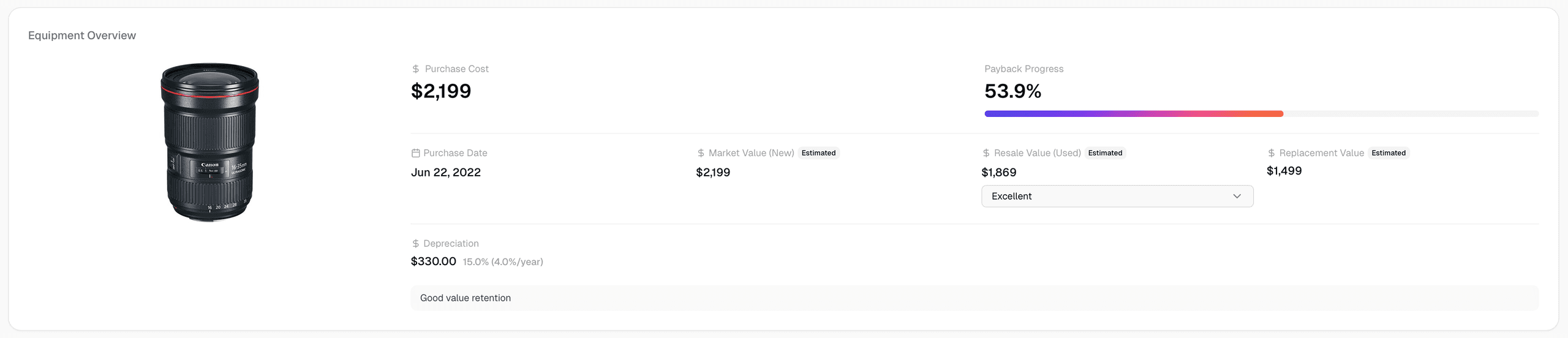
Using equipment category, age, and market data, Rental IQ calculates an estimated current resale value for each item in your inventory.
See how much value each item has lost
For every piece, see what it cost, what it is worth now, and how much value it has shed since you bought it, in dollars and as a percentage.
Make informed sell or keep decisions
When an item has earned back its cost and its resale value is declining, that is your signal to sell. Rental IQ helps you identify that window.
What makes this different
Built for production equipment
Generic depreciation curves assume office equipment or vehicles. Rental IQ uses market-aware estimates tuned to cameras, lenses, lighting, and audio gear.
Weigh earnings against lost value
Each item shows what it has earned in rentals next to what it has lost in value, so you can tell whether it is still worth keeping in the kit.
Category-specific rates
Camera bodies depreciate faster than lenses. Lighting gear holds value differently than audio equipment. Rental IQ accounts for these differences by equipment category.
Resale timing insights
The combination of payback progress and depreciation data helps you decide when to sell gear at the optimal point, after it has paid for itself but before the resale value drops too far.
Who it's for
Solo owner-operators
If you own a handful of items, depreciation tracking tells you what your kit is worth today and whether it makes sense to sell anything and reinvest.
High-volume renters
With a larger inventory, you need to manage the lifecycle of every item. Depreciation tracking shows you which gear to keep renting and which to move out.
Rental houses
For rental houses, inventory value is a balance sheet item. Depreciation tracking gives you current estimated values across your entire fleet for accounting and planning.
Related features
From the blog
Mar 19, 2026 · 8 min read
Rental House Inventory: Buy, Keep, or Sell?
A data-driven framework for rental house buy, hold, and sell decisions based on utilization rates, payback progress, and depreciation curves.
Feb 4, 2026 · 9 min read
Tax Guide for Equipment Rental Income
Taxes on equipment rental income and kit fees. Which deductions to claim, how depreciation schedules work, and when Section 179 applies.
Jan 29, 2026 · 9 min read
Best Way to Track Rental Income for Taxes
How to track equipment rental income for taxes. What records to keep, which expenses are deductible, and why tracking tools save hours at tax time.
Ready to track your rental business?
Join the waitlist to lock in launch pricing for life.